Term 1, Week 5 2026

Wellbeing Spotlight: Embracing Imperfection at Home
Many families may be familiar with The Imperfects, a podcast hosted by Hugh van Cuylenburg alongside Ryan Shelton and Josh van Cuylenburg. The podcast features honest, often vulnerable conversations about mental health, identity, shame, mistakes and the very human experience of not always getting things right. At its heart is a powerful message that our imperfections are not something to hide. They are what connect us.
This message strongly aligns with the work we do with students through The Resilience Project. At school, students regularly practise the pillars of Gratitude, Empathy and Mindfulness, often referred to as GEM. While these practices are embedded in our Foundation lessons and everyday interactions, they are even more powerful when reinforced at home.
One simple way to build gratitude as a family is by sharing three good things from the day, focusing on small, specific moments that brought joy or comfort. This shifts the focus from what went wrong to what went well and helps train young minds to notice positives even on challenging days. Empathy can be strengthened when we slow down and truly listen.
When a child shares something difficult, responding with “That sounds really disappointing” or “I can see why that mattered to you” helps them feel heard and understood before solutions are offered. Mindfulness can be as simple as taking a few slow breaths together before homework or after a busy afternoon. A short reset can help calm the nervous system and refocus attention.
One of the most valuable ideas explored on The Imperfects is that struggle is part of being human. When adults model vulnerability by sharing that they felt nervous, made a mistake or are still learning, it gives young people permission to do the same. It teaches them that belonging is not built on perfection but on authenticity. Our children are growing up in a world that often highlights polished outcomes and curated success. They need consistent reminders that it is okay to be a work in progress.
This week, consider having one intentional conversation about imperfection. You might ask, “What was something challenging this week?” or “What did you learn about yourself?” Often, children are far kinder to their friends than they are to themselves. Helping them practise that same compassion inwardly builds true resilience.
By embracing imperfection and practising GEM at home, we strengthen our children’s sense of identity, connection and confidence. Together, as a school and family community, we can continue nurturing young people who are grateful, empathetic, mindful and comfortable being beautifully imperfect.
Listen to The Imperfects podcast here:
Year 7 Classroom Insights – DigiTech: Digital Architects
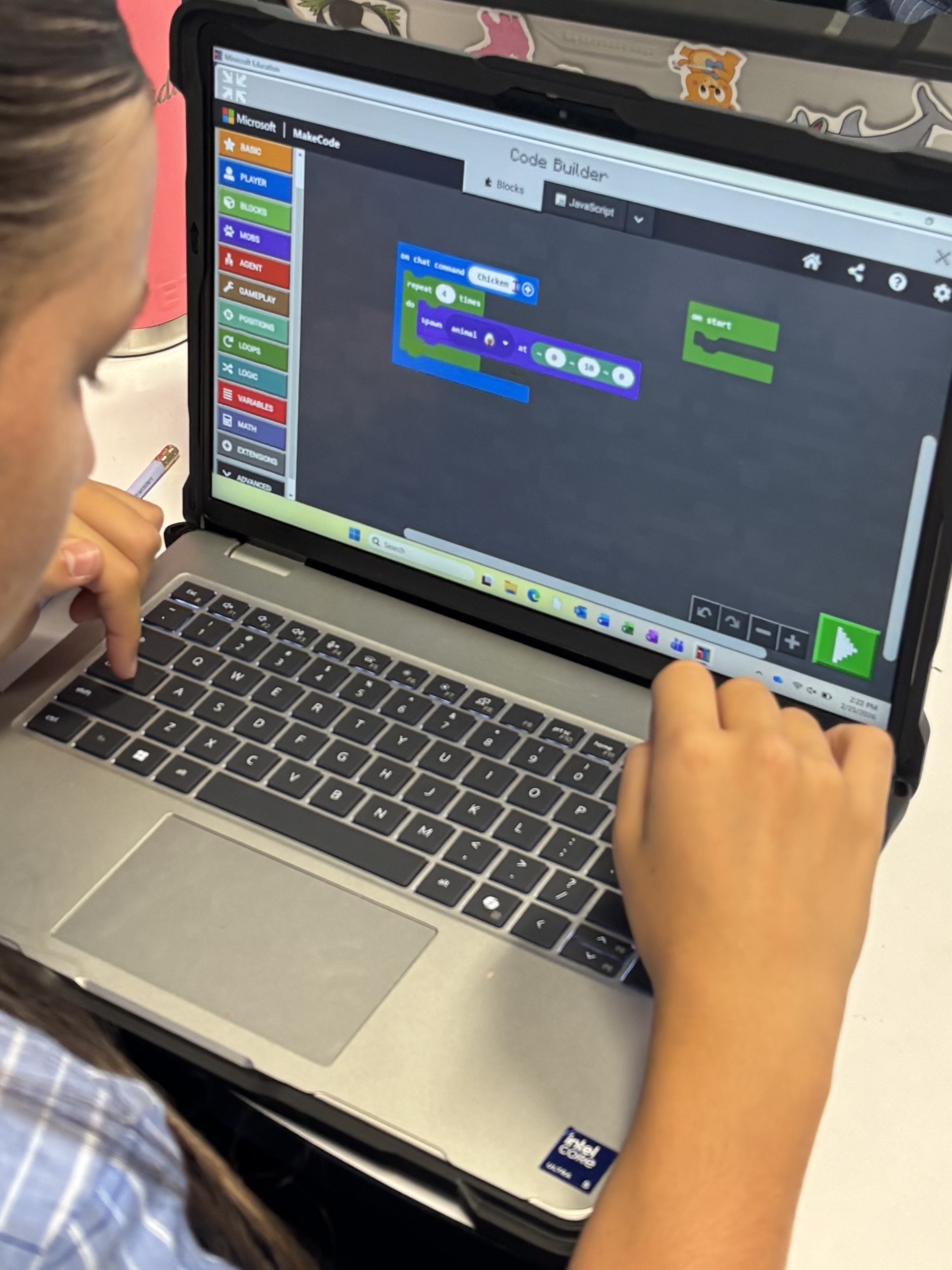
This term, our Year 7 students have stepped into the role of Digital Architects, exploring the world of coding and creative problem-solving.
Using Minecraft Education, students have been developing skills in sequencing, variables, conditionals and digital citizenship — learning not just how to code, but how to think like programmers.
Below, some students share their reflections on their learning experience and what it has been like to design, build and problem-solve in the digital world:
Noah Smith
In DigiTech so far, we have been playing and coding in Minecraft. A few of the things we have been doing while coding is chicken rain, which is where you can make any animal rain 10 blocks above you.
We have also done coordinate directions in Minecraft by adding code to place blocks in the letters N, S, E, W, U, X. We have also done ‘spleef’, which is where you're on a certain amount of snow beneath you and you have to knock the other person into the lava below with a shovel.
Digitech to me means learning how to operate a laptop and basic code to help in the future, so you don't feel old in 2050 when all this new stuff is around.
I personally have enjoyed coding in Minecraft because I got to help my peers and have a tiny weeny bit of fun LOL.
It's important to do basic lessons in Minecraft Education because in the first lesson we did Privacy Prodigy, which is where you had to find these little cute cubed things and then give them a card with the correct cube on the card. Then you go up levels, and when you finish, you have to defend them from hostile mobs if they escape from their own street.
David Vu
Could you imagine making chickens rain in Minecraft? Well, surprisingly, you can when you’re doing Digitech.
You may be wondering, “What is Digitech?” Well, Digitech is a lesson where we learn how to code in Minecraft and discover the significance of coding (which seems pretty fun to me) and how it helps in real life.
So far this year in Digitech, my class has been learning how to create code that makes flowers or gold blocks appear on the ground as we walk, and code that spawns a mass amount of chickens or mobs (pretty cool, huh?).
The things I enjoy about Digitech are learning from my mistakes when the code I’ve input doesn’t work, thinking about what the problem could be in my code, and helping others with their coding.
I think Digitech is an important skill to learn because, from now into the future, our lives revolve around technology — and they will even more in the future. It’s a good skill to have in mind if any software of yours crashes.
Before I go, want to hear a joke? Why did the chicken rain from the sky?
Be-cawwwse – we coded it to.
Year 8 Classroom Insights – Science: Food Chemistry
I enjoy food chemistry because we get to do hands-on fun experiments with food, like making ice cream in a bag and creating s’mores. This makes understanding complicated science questions easier because you get to experience the science in real time. Some things we have learnt are exothermic and endothermic reactions through the ice cream in a bag experiment and we have just learnt enzymatic browning processes by leaving cut fruit out on a plate to study how different treatments prevent browning. Overall food chemistry is an awesome way to be hands on, have fun and learn something new.
-- Zander
In Science we are doing Food Chemistry, and I really enjoyed doing all the experiments and how we do lots of hands on learning. One of the experiments we did was dipping cut up apple, pear and a banana into oil, orange juice and salt water to observe what would stop the browning of the fruit. It was really fun and interesting to see how they help stop the browning, and gave me skills to use when storing food at home.
-- Matthew
Save the Date
| Date | Event |
|---|---|
|
Thursday 5 March
|
Student-Parent-Teacher Conferences
|
|
Saturday 7 March
|
Open Day
|
Upcoming Due Dates (Weeks 6-7)
Year 7
| Date | Week | Item Due |
|---|---|---|
|
Thursday 5 March
|
Week 6
|
Ancient Innovations Portfolio Checkpoint
|
|
Friday 6 March
|
Week 6
|
Maths Topic Test: Percentages
|
|
9-13 March
|
Week 7
|
Portfolio Task Final
|
|
9-13 March
|
Week 7
|
Christian Studies Planning and Explanation Checkpoint
|
Upcoming Due Dates (Weeks 6-7)
Year 8
| Date | Week | Item Due |
|---|---|---|
|
Monday 2 March
|
Week 6
|
Science Chemistry Portfolio Final
|
|
Thursday 5 March
|
Week 6
|
Technologies Portfolio Checkpoint
|
|
2-6 March
|
Week 6
|
Music Checkpoint
|
|
Monday 9 March
|
Week 7
|
English Humanities Pitch Checkpoint
|
|
Thursday 12 March
|
Week 7
|
Maths Topic Test 3
|
|
Friday 13 March
|
Week 7
|
Christian Studies Portfolio Final
|
|
9-13 March
|
Week 7
|
HPE Final (observation and reflection)
|
Celebrating Students
Congratulations to the following students who received an award at our Term 1 assembly:
| Area | Year Level | Students | Achievement |
|---|---|---|---|
|
Learning and Academics
|
Year 7
|
William Fleming & Mabel Kenny
|
For achieving exceptional results across PAT Reading, PAT Mathematics, and Instructive, and for consistently being an outstanding contributor in class.
|
|
Learning and Academics
|
Year 8
|
Tallis Karrasch & Harrison Cole
|
Overall GPA increase between Term 3 and Term 4 reports.
|
|
Communities and Culture
|
Year 7
|
Alexis Kiss & Ruby Cole
|
For exemplifying kindness, consideration, and inclusivity, and for being a valued source of support to peers during their transition into Faith and throughout the camp experience.
|
|
Communities and Culture
|
Year 8
|
Lucy Walker & Scarlett Milne
|
For consistently and responsibly raising and packing away the College flags each day, demonstrating reliability, pride in our College, and a quiet commitment to serving our community.
|
Zooper-Dooper Awards
Our Zooper-Dooper Awards celebrate students who have been nominated by their classroom teachers for going above and beyond in living out our values, showing kindness, effort and positivity in a truly Super-Duper way.
A big shout-out to the following students who have been nominated this fortnight:
7A – Ruby Ostrofski
7B - Maddison Lawrie
7C - Jake Haynes
7D - Aaliyah Doyle
7E - Ashlee Bowe
7F - Noah Smith
8A - Eliana Neale
8B - Danielle Rickuss
8C - Stella Kluck
8D - Josie Wendt
8E - Kobie Bunnett
8F - Mahli Weedon
Absences
A friendly reminder that if your child is absent from school for any reason - including participation in school sport trials - the absence must be recorded by parents/carers via the College App or by contacting College reception.
The school is unable to log student absences on behalf of families due to various factors that can impact student attendance on any given day. For this reason, all absences need to be confirmed by families.
If you have any questions about logging an absences please speak to your child's Head of Wellbeing.